Showing posts with label Star Trek: TOS S1. Show all posts

Monday, December 24, 2012

Star Trek TOS S1 Ep12: The Menagerie, Part II

It seems fitting the latest teaser for Star Trek: Into Darkness should feature a voice over narration by Bruce Greenwood as Federation Admiral Christopher Pike given are close inspection of classic series entry, The Menagerie, the only two-part tale of Star Trek: The Original Series.


There has clearly been a great deal of speculation about what the new J.J. Abrams film, Star Trek: Into Darkness [2013], might actually bring when it finally arrives in theatres in 2013 based first upon a brief announcement and then a longer teaser.  The teaser did little to assuage concerns for original Star Trek fans.  With the arrival of its teaser trailer there is plenty of chatter and it's certainly fun to speculate what good ideas, if any, might populate this summer tent pole film.  There's no question it will look good.  Based on its Dark Knight Rises-heavy promotional poster, will the new film by Abrams provide story as much as spectacle?  Have film goers tired of dark knights, dark worlds [Thor II] and generally dark film tidings at this point?  Apart from that brilliant, vivid Enterprise bridge, will there be light in the darkness for this second go round?

To think Star Trek: Into Darkness would be a predictable action blockbuster lacking the heart and soul of the original Star Trek seems awfully pessimistic, but is it really when you consider its arrival date and the Batman effect on cinema?  Based on the reboot, will Star Trek plunge us deeper into the wonderful mythology of Star Trek's science fiction vision and universe or will it merely scratch the surface for some cheap thrills?  And do most people really care at this point?  The reimagined Star Trek certainly gave us energy, style, an alternate reboot and thrills galore to implore a new generation to discover the glories of Star Trek, but will the new film take us into brilliant new possibilities of this storied franchise once crafted so carefully by dreamer Gene Roddenberry or merely plunge us into the darkness of Jerry Bruckheimer dumb headedness, products of style over substance that so many films aspire to today. The thrilling teaser aims to lure the popcorn crowd, but are we to expect nothing more than mind numbing action like a dagger of the mind?  We shall see.


If the prediction for the latter is correct than all of the teasers to precede it will have done their job and done anything but deceive us in expectation.  I can only hope our instincts are wrong.  Super 8 was certainly an interesting combination of character and story with the a kind of movie magic that harkened back to all our yesterdays, but I'm expecting more than that and I fear Star Trek: Into Darkness will be anything but the smart science fiction of those classic Roddenberry years.  I'm not ignorant to the fact, as Edward Lakso once wrote, And The Children Shall Lead, that Abrams is the face of a new generation.  He is hardly devoid of great ideas.  Lost and Fringe continue to impress, but in film his hand has been less than assured beyond the visual excitement of today's technological wonders.  No one doubts his reverence for the creators of the series, but can he thrill beyond the visual, unlock and ignite the mind as the series once had with ideas to ponder.


Listen, Abrams can't possibly disappoint me entirely, because my expectations are low when it comes to recapturing Star Trek as I adored it.  My heart truly lies with Star Trek: The Original Series [Star Trek: TOS] more than any other incarnation.  Even the ST:TOS films, as good as many of them were, never satiated my fix entirely concerning the magic of the original Star TrekStar Trek: The Next Generation, Voyager and Enterprise have all been more satisfying to me.  Serialized television certainly has its advantages and the franchise certainly impresses over the time constraints of a theatrical film.  So, my expectations have always been low for the films and this new film may surprise me yet as a result of it.  I will temper my skepticism with the realities of summer films, but apart from being entertained it's difficult to be optimistic based on the evidence.

In the meantime, we continue our look at one of the smartest tales in science fiction, Star Trek: The Original Series, Season One, Episode 12, The Menagerie, Part II.


Picking up where we left off with The Menagerie, Part I, Spock has pleaded guilty in a general court-martial for sabotage, returning to Talos IV and attempting to return Captain Christopher Pike there.  In the immortal words and delivery of Captain James T. Kirk, but "Whhhy?" To find out more, The Keeper of the Talosians continues to beam images to the U.S.S. Enterprise.  A small confession would have me admit to you that, as a boy, I affectionately referred to the Talosians as the "fanny heads." The fanny heads, little did I know back in the day thanks to Star Trek's exceptional make-up arm, were delicately portrayed by several women including Meg Wyllie as The Keeper.

Returning to footage excerpted from The Cage we find Captain Pike is encased within a glass cage.  He his spoken with telepathically by the Talosians who intend on beginning the "experiment."


On board the Enterprise, Number One, Spock and the cast of The Cage dissect the reasons for these illusions foisted upon the unsuspecting crew by the Talosians.  It's fascinating how the Spock character had not been fully developed and worked out regarding the character's behavioral details. He shows more emotion than normal meaning he is far less restrained as far as the Spock character is concerned that we would come to know and love.  Number One makes the decision to blast their way through the planet's metallic crust.  It's a fairly bold moment when you consider a female officer in charge of a starship's lethal power.

The Talosians transport Pike to Rygel VII using his mind's memories for the first of three distinct illusions.  Vina is there, but Pike deduces correctly that it is nothing more than a mental construct imprinted by the Talosians.  The Talosians utilize fragments of his mental past and then bend it to their own whims as part of their experiment.


Following the viewing of a lengthy battle of hand to hand combat on Rygel VII with a barbarian warrior, the disfigured Pike of The Menagerie demonstrates fatigue.  Spock explains to Kirk and Mendez that the trial must take a recess.  He makes it clear the Talosians want Pike returned to them alive.

The Enterprise closes in on Talos IV and the trial resumes.  Footage continues to exhibit the idea that the Talosians are examining their specimen, but channelling the Smashing Pumpkins despite all his rage Pike is still just a rat in the cage.


Vina presents herself as a gift to Pike.  She's beautiful, but he is unmoved by her displays of affection not because she isn't attractive to him, but because these aliens have removed Pike's freedom.  Our innate desire to be free of enslavement is an overwhelming and unstoppable drive.  He yearns to know how to defeat the Talosians from their mental probing.


Futile efforts are made by Number One, Spock and company to blast their way through the Talosian entrance.  It is clear to me that Majel Barrett was anything but "annoying" as people of the era unfairly received her in the role of Number One.  This brief evidence suggests the Number One character as portrayed by the actress would have evolved and potentially made for another fascinating character aboard the Enterprise.  She would have indeed made a splendid early incarnation of a Kathryn Janeway-like character if you will.


Meanwhile, in The Cage, Vina warns Pike the Talosians are not averse to punishment, like gods, should Pike not cooperate with their expected responses from assorted illusions acting as variables within their experiment.  And for the first time we get a hint of what has become of this race through Vina's explanation as she conveys the ideas and thoughts of the late, great Gene Roddenberry.


It is without question that Star Trek: TOS's second pilot, Where No Man Has Gone Before, feels like a natural extension of The Cage and its bold ideas and narrative sense as far as Roddenberry's science fiction goes. What's a little troubling is how some of the concepts seem to find their way into Lost In Space.  It's interesting to consider that some of the thinking explored here and some of the ideas here are echoed particularly in Lost In Space's excellent two-part entry, The Keeper.  The two-part The Menagerie aired in November 1966, while The Keeper aired two months later in January 1966.  While it's unlikely The Keeper would draw upon ideas from The Menagerie in such a short window the greater history surrounding the two series makes the connection a little more fascinating and possible.  Because The Cage script was floated about before its rejection back in 1964, while the The Cage pilot was completed at the end of 1964 and the beginning of 1965.  While such Noah's Ark-like concepts are hardly new, the idea of a Keeper, and "specimens" housed within a cage were at the heart of Roddenberry's proposal.  What's interesting is Star Trek: TOS's more philosophical approach to the idea and concepts, while Lost In Space take a more literal, tangible translation of these ideas for its child-friendly audience.  Was Lost In Space's The Keeper just mere coincidence or did Roddenberry's script ideas influence the stories of Lost In Space?  It wasn't unusual for actors to appear in both series, but how funny actor Malachi Throne should appear in both Lost in Space, appropriately-titled The Thief Of Outer Space, and Star Trek: TOS. But the Lost In Space, The Keeper comparisons are startling and some of the video clips included here suggest those distinct possibilities.  I'm a huge fan of both series, but I still find new details can be gleaned from their historical connections.  It seems unlikely these coincidences are attributed to nothing more than mere speculation.  "Is the Keeper actually communicating with one of his animals?," inquires Pike.


So, Talos IV is only now beginning to support life again after the Talosians went underground thousands of years ago.  Vina explains she is a human woman as real as Pike despite his skepticism as a result of the mind games.  She explains they are like Adam and Eve, an idea that would take further fruit in Samuel A. Peeples, Where No Man Has Gone Before, the second Star Trek: TOS pilot, which actually aired as the third official episode of Season One in September 1966, which again explained for some of the character inconsistencies and, in the case of Dr. Leonard "Bones" McCoy, absences altogether.


As the episode flips back to the court room, Mendez acknowledges that these specimens were being maintained as nothing more than "breeding stock" heightening and underscoring the nature of this alien experimentation.  Kirk gives us that famous, "Whhhy?"  William Shatner could deliver a word on a dime.

The Keeper uses Pike's mind against him when required.  The Keeper confirms that while the illusion that brought Pike and his crew to Talos IV was just that, an illusion, there was a shipwreck and Vina was the sole survivor.  But Pike begins to realize his Talosian captors are doing all they can to make Vina desirable to him, but more than he fully understands.  The Talosians wish to perpetuate the species.  If Pike is happy with Vina procreation will be optimal.  This is the operating factor for the Talosians.  Survival of their species is paramount.  Thus the Vina show continues for the benefit of Pike.


Pike is mentally transported back home to his rural life complete with horses (and, bonus, Vina).  Pike knows it's not real.  "We're in a menagerie - a cage!," declares a frustrated Pike.  Vina reveals to Pike that the Talosians cannot read through primitive emotions.  They are incapable. Vina also admits that her thoughts have been essentially raped by the aliens.  They know precisely what kind of man she desires.  They brought Pike to her for that reason.  Vina cannot help but love him.  He is a near perfect construct from her mind brought to life. Pike begins to cloak his mind with anger and rage to prevent the Talosians from probing his mind.

Within seconds Pike is quickly whisked away to a third and final fantastical place where Vina has transformed into one of the iconic images associated with Star Trek: TOS, the green Orion slave girl.  The fabrication is intentional.  The Orion slave girl is said to be seductive and utterly irresistible to man and her erotic dance may have something to do with it.


On board the Enterprise, Kirk narrates his observations regarding the evidence.  He realizes that Vina is presented to Pike in a variety of tempting forms, like those presented to Adam and Eve, and the mental assault begins to weaken him.  Kirk himself seems to identify with Pike's plight.  He should.  Kirk took his place amongst the stars populated with beautiful alien women constantly bombarding his own male psyche with female delights and their physical bodies.

Returning to the archive footage, Vina returns to her illusory new normal just as Number One and Yeoman J.M. Colt beam down in an effort to save Captain Pike.  Four men, including Spock, attempt to beam down with them but are left behind by the Talosians.


On the surface of Talos IV the addition of Number One and Colt allow for the Talosians to offer their would be Adam the choice of three female partners.  Pike refuses to play their game instead attempting to fill his mind with hate and rage to block their ability at mentally probing him.  Can you imagine Kirk in a three-way here?  Come on, it is conceivable.

In a terrific science fiction moment, the Keeper attempts to open a small passage way and reacquire the guns inside The Cage, but Pike is alert and pounces on him like a tiger.  As Pike strangles The Keeper he transforms into a beastly monster to play on the fears of his captors.  The Keeper warns he should be released thus he use illusion to destroy the Enterprise.  These were indeed indelible, horrifying moments glimpsed as a child and yet these scenes remain as powerful today.


Back aboard the Enterprise, in real time, the images of the events on Talos IV cease beaming to the Enterprise.  Spock urges the court to await with patience.  Comodore Mendez wishes for a verdict from the essentially motionless and disfigured Pike.  Actor Sean Kenney shows remarkable emotional depth despite his limited physical role.  Spock urges Pike to be patient.  "Captain, please, it's your life now - at least a chance for life."  Kirk begins to put the pieces together regarding Spock's overriding theme for life, but is still at odds with Talos IV as a prison or a cage and why Spock would bring him there.  It's still not quite adding up.   What is adding up is complexity of character within one of science fiction's greatest creations by Gene Roddenberry - the character of Spock.


With the images concluded from Talos IV the panel votes and all vote guilty as charged concerning Spock including Pike.  The bridge of the Enterprise reports to Kirk that it is entering Talos IV's orbit.  Spock assures them that Talos IV controls the Enterprise now as it did thirteen years ago and that they will soon discover why.


The images of the events of thirteen years ago continue.  With The Keeper held hostage at phaser point, Pike, Number One, Colt and Vina escape to the surface.  Pike must choose one of the women to endure with and with whom he will lead a "carefully guided" life.  Pike submits he is willing to stay on Talos IV with the lovely Vina as long as the Talosians release Number One and Colt along with the Enterprise.  Has Pike chosen his mate?  It's clear he understands Vina has acclimated to the existence on Talos IV beyond being an attractive mate.  Number One suggests it is enslavement to live this way and rigs her phaser to build an overload to create a force chamber explosion.


The Keeper believes humans not only disdain captivity but refuse it even under the most benevolent and benign of conditions.  Thus the Talosians deem humans "too violent" and "dangerous" and ultimately too unpredictable for their "needs."  Vina tells Pike and the others they are free to return to the Enterprise.  The irony, of course, is that the aliens simply don't comprehend human nature.  Pike's behavior was out of self-preservation.  His anger was a  fight for freedom and the retention of free will.  This is what Pike's actions represented.  In the end he is ultimately set free, but philosophically the Talosians don't understand the rejection of their benign sense of illusion that they perceive as freedom. This is an inherent gift to Talosians rather than a mental imprisonment as rejected by humanity.  The great irony, of course, is that the illusory imprisonment that Pike railed against throughout The Cage and, of course, here in The Menagerie against the powers of the Talosians ultimately becomes a gift to one human following the blatant disregard of the law and Starfleet regulations concerning Talos IV.  The Talosian ability becomes a liberating power to free Pike of his physical imprisonment.  He could now shed his physical skin and disability to live freely even if through an illusion.  It speaks volumes about humanity's value for physical freedom.  Conversely, if understood properly by humanity, and not just Spock's recognition of this Talosian potential, would it not be harnessed for the physically handicapped?  These are the brilliant big ideas and philosophical underpinnings that would make Star Trek: TOS the lasting success of science fiction when all others would flounder.  Does not the virtual world today allow for a similar kind of freedom and escape?  Star Trek: TOS was way ahead of its time.


"And that's it, no apologies," says Pike.  "Your unsuitability has condemned the Talosian race to eventual death," declares a Talosian.  The Keeper believes Pike was their last hope, but that ultimately humans would learn of their powers  and destroy itself.  Roddenberry paints a cautionary tale of man and the harnessing of powers and technology to humanity's detriment.  Vina informs Pike she cannot return to the ship with him and the others.

Remarkably, in a very delicate and carefully edited transformation, the illusion of Vina's beauty is removed as she ages and morphs into the scarred, elder woman that has survived on Talos IV.  She is essentially embarrassed by her disfigurement.  This is not only a touching moment, but a demonstrative moment by Pike of true human compassion.


Interesting that The Keeper eventually shares the truth of Vina's condition with Pike only after Number One and Colt have been returned to the Enterprise to spare Vina of any additional emotional anguish.


In probably the most incredible twist of the installment, Kirk turns to Mendez also out of human compassion looking to him for some understanding to be evaluated and levied toward his first officer Spock.  Kirk understands this is essentially a mission of mercy for Pike and that Spock has demonstrated true human compassion for his former captain.  His actions, while severe and perhaps unnecessarily radical, were to assure that Pike would truly have a second chance at life.  But when Kirk turns to Mendez, the Comodore disappears, nothing more than an illusion created by the Talosians.  That was a stunning and believable twist and still is today.  Mendez may have been real, but at a certain point, he was created as a construct for Kirk and that illusion replaced the real Mendez as Kirk made his journey back to the Enterprise.


The Talosians created the "fiction" of a court-martial to stall Kirk from regaining control of the Enterprise and give Spock time enough to return Pike to Talos IV.  The Keeper invites Pike to remain on Talos IV with them and ultimately shed the constraints of his physical prison and broken body in order to move freely about Talos IV.  Additionally, the act is not entirely selfless as the Talosians have renewed hope toward their long-term survival.


This brief exchange between Kirk and Spock is a terrific moment because naturally viewers are thinking the same thing.  Ultimately, Spock's decision was out of protection for his Captain.  It was in many respects an entirely selfless act purely engaged out of respect and compassion for his former and current Captain despite having to resort to extreme measures.


The real Mendez releases a statement from Starbase 11 that Spock's actions will not be deemed illegal and thus his life shall be spared.  All actions taken on behalf of Pike are thereby granted and thus all charges under guiding principles of General Order 7 concerning contact with Talos IV are thereby suspended.


Kirk asks Christopher Pike if he wishes to leave for Talos IV to which he replies in the affirmative.  Kirk empowers Pike with an act of choice and free will in his final screen moments. The moment is extraordinarily tender.  It is in this moment we would be remiss not mention, like Spock, Kirk, too, exemplifies great range as a captain, a leader and a human being. The portrait of the Kirk character is also given tremendous depth.


With this option, Star Trek: TOS essentially creates a scenario tantamount to ascension explored in Stargate SG-1.  Here the shedding of the physical earthly body still requires the physical body to exist in The Menagerie.  The physical body must live to allow for the connection.  Dr. Daniel Jackson, played by Michael Shanks, shed his physical vessel at the end of Season Five (Meridian) of Stargate SG-1 following exposure to a lethal dose of radiation. Jackson had to ascend and leave the physical self.


The relationship between Spock and Kirk continues to mature, demonstrate humor, love and respect as Season One of Star Trek: TOS continues to gradually build unforced upon its principals and the natural chemistry between them.


Despite the utter impossibility of Spock and Pike making it to the transporter room and beaming down to Talos IV mere moments after Spock's exchange with Kirk, the Talosians beam images of Pike holding hands with Vina on Talos IV back to Kirk.  Of course, this could be the simple craft of Talosian illusion too - the gift of things to come.  This leaves a remarkably happy ending to a fairly complex tale of science fiction illusion and reality.  The final credits appear on the screen as Kirk looks to the viewing screen with a smile.  The Menagerie Part II focuses almost entirely on the events of The Cage and Dr. Leonard Bones McCoy doesn't make the cut in this second portion.  The second portion of The Menagerie lacks the thrilling motivational build of the first installment that focused on Spock and the dynamic of the new crew and thus I would tip my hand to favoring the first portion a touch more.  Taken on the whole though, The Menagerie is a wonderfully penned, edited, performed sci-fi tale and one that never requires big explosions or major special effects spectacles.  Can you imagine a story like The Menagerie today?  Something this good might have to be deemed an illusion. They just don't make them like this anymore.


What is so remarkable about The Menagerie is how it endures through big ideas, exploration, the unknown, quiet contemplation. There are no cliched revenge proclamations to establish endless action sequences. The final image of Kirk in the court room of the Enterprise in Part I is sobering and striking in its audacity to present science fiction for the thinking man.  The reason new Star Trek film incarnations will never rival the fine science fiction ideas of the past is simply because they are generally big, bold spectacle pictures disinterested in going where no man has gone before.  The Menagerie is wonderfully plotted and thoughtful replete with aliens and alien ideas that are frighteningly intimate and strikingly real.    There is empathy, misunderstanding and natural instincts for such concepts as freedom, survival and even the pursuit of happiness.  Can you imagine such arcane ideas in play today?  Star Trek: The Original Series was one of a kind and through The Menagerie Roddenberry wove a work of human splendor.


William Shatner recently told the Pittsburgh Post-Gazette of the upcoming Star Trek: Into Darkness, "It doesn't have the story heart that the best of my Star Trek had," and while that remains to be seen as of this writing I suspect he may not be wrong.  Still, Shatner is right about one thing, Star Trek: TOS, including The Menagerie, had heart in spades. There's absolutely no shortage of it and the new stuff will never touch it.  All the explosions in the world will never distract from the empty shell of summer entertainment.  That's just the reality of things. And the reality is science fiction of the caliber of Star Trek: TOS is ultimately becoming scarce and even more scant in the summer season.


Maybe Star Trek: TOS lacked the explosive thrills of today's technological nightmares, but it more than made up for the pomp and flash by thrilling the mind with vivid ideas and smart writing.  Have we not become victims of our own technological successes in cinema today?  Back in the 1960s, there was never a need for the spectacle of today's films and television, yet series like The Twilight Zone, Outer Limits and Star Trek: TOS endure because of story strength and depth of character.  It was never about the effects and this is why those series are still heralded and played today.  New Year's Day has traditionally seen the Sci-Fi Channel, excuse me, the SyFy Channel, run a day long marathon of The Twilight Zone.  How many series come and go never to be heard from again.  Sci-fi contemporaries may look good, but they don't necessarily have much to say with rare exceptions.  We have truly distracted ourselves, enamored and duped by the wonders of technology in today's productions, which overwhelm the senses and good sense in general.  I'm just hoping the new film is better than Transformers. That alone would mark something of a success in the summer of 2013. My apologies for pessimism and please let me temper it.  I suppose if a film is slated for the summer we shouldn't expect The X-Files. Wait a minute, after all, the chance to believe is an option. It says something about why such material is so rare. It can be both though. Unfortunately, spectacle is what sells those summer tickets.  Science fiction for the mind is something entirely different and many simply refuse to have the patience for it on the big screen.


Perhaps it's unfair to make the comparisons.  Television and film are a bit like apples and oranges.  What the folks behind Star Trek: Into Darkness [J.J. Abrams, Bryan Burk, Damon Lindelof, Alex Kurtzman, Roberto Orci] have done for television between Lost, Fringe and even Person Of Interest is certainly of the highest quality.  I expect greater things to come.  Expecting them to work the same miracles in two hours may be unfair, but it is possible.  I continue to anticipate big things from these writers and producers, but perhaps a new TV series is in order for Star Trek.  While I think the films should not be limited to action bonanzas, I'm not sure this is the perfect vehicle for the group when it cmes to Star Trek.  I do hope that the Enterprise incident of the summer of 2013 that is Star Trek: Into Darkness will land a spot on my favorite films list one day, but Star Trek is philosophically a stronger vehicle on television.  I fear with comparisons to the original ideals of Star Trek so well-articulated and produced for television, today, for theatres, may have me reciting for the world is hollow and I have touched the sky long ago.  In the meantime, we have those classics to mine and enjoy on our shelves when we're looking for a little more depth with our entertainment. The Menagerie is a prime example of excellence in science fiction entertainment and the team behind the latest film have the ability.  I'm just not sure they have the canvas.  Roddenberry's classic was indeed the inspiration.  And can you believe no one had to die? Fascinating.

The Menagerie Part II: A. Director: Robert Butler. Writer: Gene Roddenberry.


Dead Crewman: 0. Dead Crewman To Date: 10.  Babe Alert: 0.  Babe Alert To Date: 13.

Actress footnote: Meg Wyllie [1917-2002]. American born. The late, amazing Meg Wyllie enjoyed a pretty prosperous career in television.  She appeared in The Twilight Zone, The Untouchables, Wagon Train, The Addams Family, Mister Ed, The Fugitive, Perry Mason, Lassie, Batman, Bewitched, The Courtship Of Eddie's Father, Gunsmoke, The Bob Newhart Show, General Hospital, Emergency!, Charlie's Angels, The Love Boat, Eight Is Enough, Benson, Highway to Heaven, The Facts of Life, Family Ties, Who's The Boss, Designing Women, Night Court, The Golden Girls and Mad About You.  And that my friends is just a portion of her credits.

Wednesday, December 19, 2012

Star Trek TOS S1 Ep11: The Menagerie, Part I

"I thought highly of him.  He would have made a grand captain."
-Gene Roddenberry commenting on actor Jeffrey Hunter in Starlog #231. The now defunct magazine noted correctly that he was the "first hero of Star Trek."


The Menagerie is perhaps one of the strongest cases for the talents of television editors ever committed to television. The importance of editing would almost lead me to proclaim, "it's all about the editors."  They literally create a new story here out of the ashes of original Star Trek pilot The CageThe Menagerie is a seamless weave of new material, relative to 1966, coupled with extracts from the original Star Trek pilot, The Cage, penned by writer/creator Gene Roddenberry.


Looking back, there is plenty of back story surrounding just how The Menagerie became the much lauded and equally classic direct descendant of The Cage.  William Shatner with Chris Kreski capture the period best in the book MemoriesThe Cage was fantastic for many reasons and things as you'll discover throughout two-part The Menagerie.  Concept Ideas like the U.S.S. Yorktown and Captain April yielded to the iconic creations of the U.S.S. Enterprise and initially Captain Christopher Pike for The Cage.  The then married Roddenberry had been falling in love with actress Majel Barrett.  He created the role of Number One for her.  The iconic reference of Number One would live on with greater resonance and impact on Star Trek: The Next Generation in the form of William T. Riker played by Jonathan Frakes.


Sadly, Roddenberry's ideas were allegedly rejected by CBS who ultimately pillaged those ideas and applied them to their own series... the almost equally beloved Lost In Space, at least according to Memories.  Ultimately, not only did CBS pass initially, but the folks Roddenberry intended to impress over at NBC passed too.  The executives felt it lacked "sufficient action" and was "too cerebral."  It was ambitious and the executives knew it, but as Shatner pointed out, "it was smart, beautiful, intellectual and thoroughly engaging.  In other words a flop."  At least as far as the suits were concerned.


Despite being a striking, splendid piece of television The Cage was turned down.  Compounding matters, Number One was too "pushy" and even women found her "annoying."  This was the 1960s mind you.  Further, the suits also "loathed" Spock.  The two characters had to go if Roddenberry was to continue.  To the surprise of many, despite a $686,000 dollar pilot flop, NBC green-lighted a second pilot.


To move forward several stipulations were in place.  The executives wanted Number One and Spock to be removed.  There was no room for a Satanic-looking alien nor an independent woman in the 1960s helming a starship.  There was apparently no desire to see her boldly going anywhere at least on television anyway.  So Number One was inevitably removed following The Cage in part and with the hopes Gene Roddenberry would be able to retain his Spock character as a pivotal part of the dramatic fulcrum for which he had in mind for his Star Trek tales.  Roddenberry fought tooth and nail to keep Spock to the detriment of Barrett's role for his impassioned vision.  Ultimately, Nurse Christine Chapel and other roles awaited Barrett and her love and affection for Roddenberry never dimmed despite disappointment over her removal.  And though Roddenberry promised to make Spock a background character he had every intention of defying his network masters.


What came next, of course, was the second official Star Trek pilot, Where No Man Has Gone Before.  Number One was out. Spock survived and would endure.  The budget was tightened.  More action was provided yet the cerebral was largely retained.  Somewhat unexpectedly, actor Jeffrey Hunter, who performed impressively as Captain Pike, was out largely due to the conflicts over the role and the meddling by his then wife.  Hawaii 5-0's Jack Lord was a potential replacement but demanded too much.  Fortunately, an already stunningly wild production was made even better when the creative team behind Star Trek landed a coup in William Shatner who had been enjoying success in Alfred Hitchcock Presents, The Outer Limits and The Twilight Zone.  The hopes and dreams of Star Trek fans the world over was nearly cemented.  George Takei as Sulu and James Doohan as Chief Engineer Montgomery Scott were added.  Where No Man Has Gone Before greenlit the series.  First episode, The Man Trap, sealed and completed the deal with the addition of Grace Lee Whitney as Yeoman Janice Rand and most importantly DeForest Kelley as Chief Medical Officer Dr. Leonard "Bones" McCoy.  The rest is history as they say.


The Menagerie offers a wonderful glimpse into the seeds of Star Trek as a fusion of The Cage combined with its Shatner-driven vision.  Roddenberry knew one day The Cage would see the light of day and The Menagerie weaves his original story and ideas into this wonderfully complex and beautiful tapestry that would once again be a hallmark of an outstanding first season of Star Trek: The Original SeriesThe Cage is cleverly reworked into the appropriately titled The Menagerie, an episode, by definition, is luxuriously edited and stunningly curious in all of its dramatic splendor as a science fiction story. It is an ingenious mix of found footage (so to speak) and science fiction storytelling and one that had a profound effect on me as a young boy.


Even as a young person, the message of a handicapped man, crippled by physical limitations, essentially set free by the advanced technologies of a greater intelligence, was at once liberating and profoundly moving to me as a statement and representation of the possibilities of science fiction. It's impact did not come lightly and Star Trek: The Original Series, while maybe not the first, was my indeed one of my first encounters with the great potential of science that we witness impacting the human race today.

The impact of Season One of Star Trek: The Original Series certainly cannot be understated on me and many others.  There was rarely an episode from that season or the series, that didn't somehow leave an indelible mark or impression on me.


Stories were played and replayed in syndication and I spent many nights with my grandmother watching them.  She was a fan too.  How often does a series cross generational divides?  Episodes like The Man Trap, Charlie X, The Naked Time, and Mudd's Women all left a significant imprint on me.  I recollect them with ease and effortlessly play them back in my mind.  They remain unforgettable to me and others.  This is why Star Trek lives on for so many as the incontrovertible science fiction classic.  Space:1999 and Battlestar Galactica are two that have their special place, but none have held the kind of nostalgic strength coupled with indisputably memorable characters and the lasting storytelling genius of true science fiction writers.  The Menagerie is no exception.  It represents one of my earliest memories of Star Trek and also one of the most unusual viewing experiences combining creepy science fiction with bold characters like nothing I had ever encountered in my young life.


My heart bled for Captain Pike, played in The Menagerie's new footage here by a heavily made-up Sean Kenney, who helplessly sat motionless and near stone-faced in that chair. Kenney was so convincing to me in that limited and limiting role, along with the superior talents of the series make-up and production department, I fully believed the realities of The Menagerie. I also fully believed Kenney and Hunter were one-in-the-same actor as Pike.  My young eyes never differentiated the two actors in the story.  The story was also truly disturbing, heart-wrenching stuff surrounding the tale of a once great man now disabled and disfigured. How could fate be so cruel? It was one of those early lessons in life regarding the remarkably random nature of life's unpredictable cruelty. It had my undivided attention along with my empathy which seemed to be awakened in my young self through episodes like this one.


As alien as the solutions were and as defiant as Spock's actions in The Menagerie, we connected to the internal logic of man's potential to live and will to live.  But more importantly, the half-human, half-Vulcan Spock seemed to recognize the value of living too and the value of human dignity and the outcome seemed somehow sound in its determination. We rooted for Spock and Pike and prayed for them.  Spock's actions may have defied Starfleet and dumbfounded Kirk, but somehow seemed logical on a human level, and ironically, an emotional one.  Spock responded heroically.  Roddenberry saw the value and benefit of his conflicted Spock character to the series and The Menagerie is a fine example of that vision.


Let us return to the confinement of physical man and the potential for humanity to transcend the body, ascend if you will, free the mind and spirit to live again. Let us look at the spiritual renewal of Star Trek: The Original Series, Season One, Episode 11, The Menagerie. This was the baby of one Gene Roddenberry at his very best.

Captain James T. Kirk, Spock and Leonard "Bones" McCoy, the standard bearer of casting triangles, divert to Starbase 11.  Greeted by the latest in a long bevy of beautifully adorned red shirts, Miss Lt. Piper, the triumvirate is escorted to see the Comodore.  Kirk explains that first officer Spock received an urgent sub-space message from one Captain Christopher Pike.  Comodore Jose I. Mendez is surprised and Kirk asks "Why?"  An air of mystery is generated immediately with the scene as viewers immediately desire to know more about what happened to Captain Pike.  The Comodore takes them to the intensive care unit.


Kirk met Pike when he became a fleet captain.  Spock served with Pike for eleven years, four months and five days.

As it turns out, the once handsome Pike toured a cadet vessel, an old class J starship.  One of the plates ruptured and Pike was burned severely by radiation exposure to delta rays while he made every effort to save young cadets.

Again, when Pike does appear on screen physically disfigured we have no idea that this is no longer Jeffrey Hunter, but rather Sean Kenney in the role of Pike, at least my horrified, young, innocent little eyes had no discerning idea back in the day.  The visual deception still holds up exceptionally.  The Star Trek production team was that good.


Pike, now deformed, paralyzed and living in a chair, communicates with a series of lights and beeps.  Two (2) flashes/beeps means NO.  He is disinterested in meeting with the visitors.  Spock requests a moment of his time to which he responds with one beep.  Additionally, Pike's eyes immediately look to Spock clearly stimulated by the voice of his old shipmate.  As a child, I never really noticed Pike's eyes moving and the emotion in those moments.  Perhaps the details went unnoticed in all the generalized wonder of each episode.  The others leave and Spock speaks with Pike alone.  Spock tells him he should know why he has come.  There is indeed some kind of loyalty there for Spock.  "It's only six days away at maximum warp and I have it well-planned" to which Pike flashes twice perhaps out of concern for Spock.  Spock suggests to his old Captain, despite Pike's rejection of his plan, that he must do this for him despite never having disobeyed his orders before.  Clearly, Spock, a Vulcan, has heard the sub-space chatter regarding Pike's condition and expresses an empathic human connection.  His plan may indeed be a treacherous act of mutiny, but Spock is willing to commit that risky act demonstrating either one final act of loyalty to his old Captain or, fascinatingly, the human emotion compassion to the potential detriment of his career.


Later, a further investigation by Kirk regarding Spock's report of Pike's sub-space transmission turns up nothing coming or going out of the Enterprise.  Kirk is annoyed even angered by the Comodore's questions, because Kirk understands it calls into question certain facts and Kirk has great faith in the men and women aboard his starship vessel particularly Spock.  If anyone aboard the ship has embraced the green-blooded Vulcan it is indeed Kirk. By default it calls into question Kirk's judgment.  Kirk is forced into a defensive posture attempting to make sense of the undocumented and support his first officer despite having no proof the transmission ever happened.  Kirk, in effect, realizes something is amiss but makes every effort to give Spock the benefit of any doubt incurred.  Kirk proves he will go to the wall for his crew.  But one thing is certain Kirk will be displeased with any omissions by his people or at least look for a logical explanation. Until then, Kirk doesn't even consider a deceit by Spock because he would have granted leave if requested without question.  So why would Spock do it?


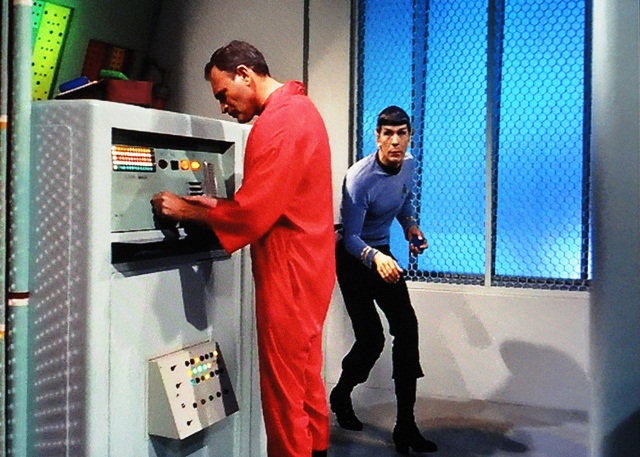
The Comodore and Kirk check computers.  Meanwhile on Starbase 11, Spock enters the computer room and his act of sabotage feels very unnatural when one contemplates the logic of Spock and puts viewers in a position of discomfort and unease.  Therefore, something logical must be in play.  Will it be enough to justify Spock's actions?  Spock exacts a quick Vulcan Neck-pinch and his plan to alter or modify the computer begins.

Miss Piper (through the traditional Star Trek filtered lens - the handiwork of Jerry Finnerman) reports, but first mentions a Miss Helen Johanssen as a woman who brought Kirk to her attention. The simple moment adds to the womanizing mystique and legend that is Kirk and his conquest of the ladies.


Miss Piper reports that Spock's years of service and "extreme loyalty to this former commander" are the only two factors that remain noteworthy from her investigation.  Kirk perks up, "A Vulcan can no sooner be disloyal than he can exist without breathing that goes for his present commander as well as his past."  This statement is entirely logical and stands in stark contrast to the actions on display by Spock.  Miss Piper confirms that it would be impossible for Pike to send a message.  The Comodore confirms he speaks in affirmatives and negatives and that he is kept alive mechanically. His mind is active and fertile but he is incapable of real communication.  Kirk begins to realize that Pike would be unable to even request such a message be delivered.

Back in the computer room, Spock is embroiled in a physical altercation with a tech and a truly violent confrontation ensues before Spock implements his second Vulcan Neck-pinch to subdue his assailant.  Spock is doling out and throwing down on the Vulcan nenck pinches.  Once again, we are truly concerned with Spock's actions clearly in opposition to the behavior of a Starfleet first officer.  Would someone please explain the reason for this strange behavior? [Quote from Skin Trade by Duran Duran].  Well, as it turns out, in order to get the crew of the Enterprise to comply with Spock's directives he utilizes Kirk's voice through a pre-programmed disc that informs them they are to accept instruction from Spock.  In essence the subversive Spock informs the crew on the bridge of the Enterprise to remain silent until instructed.  One aspect of Spock's character that does remain true is an almost cool, calm, methodical approach to whatever it is he is trying to achieve on behalf of Pike. This was indeed always one of the qualities that drew us to his character and the series.


Elsewhere, Kirk and Bones monitor Pike who continues to flash.  Why? wonders Kirk.  "The brain is what life is all about," admits Bones, but Pike is unable to express himself outwardly and no one is able to reach him or at least be satisfied in the knowledge that he comprehends them.  Kirk begins to wonder if Spock is involved.  This is the kind of fiery exchange we grew to love between Kirk, Bones and Spock along the journey that was Star Trek: The Original Series.  In this heated moment, Kirk is at a boiling point and Bones demonstrates his loyalty to Spock as a colleague and friend, despite his sometimes combative stance with the green-blooded Vulcan.  Down deep Bones exhibits a genuine belief in Spock's actions as founded in something righteous because his humanity or that which could possibly be irrational is essentially "submerged."  Kirk questions recent actions, because as the Captain he must and he pulls no punches even with Bones suggesting he would suspect him if necessary.  Shatner always delicately walks that line of captain and friend to brilliant effect.  Kirk is accurate in pointing out one point of fact, that the Vulcan is also half-human.  It is this inner conflict in which Roddenberry envisaged a great many dramatic flashpoints.


Bones is summoned back to the Enterprise. The Comodore presents a log book of Talos IV to Kirk.  It is marked TOP SECRET FOR EYES OF STARFLEET COMMAND ONLY.  Kirk understands General Order 7 applies to Talos IV.  "No vessel under any condition emergency or otherwise is to visit Talos IV."  To do so could result in the death penalty.  This severe punishment is the only remaining death penalty charge on the books.  The log reveals that only one ship ever visited Talos IV, the U.S.S. Enterprise.  Both Pike and Spock have recommended "no human should ever visit it again."  During their discussion Piper realizes Pike is missing from their monitors. The computer room on Starbase 11 informs Kirk and the Comodore that the Enterprise is leaving orbit.  We get that classic camera zoom on the alarmed face of Kirk.  His expression is only heightened by the accompaniment of one of the best television scores to ever be assembled and recorded always arriving at just the right moment with just the right amount of dramatic punctuation.


The Enterprise leaves the orbit of Starbase 11.  Spock is all business and orders Uhura to maintain radio silence. Spock informs the crew he has been placed in charge and that their destination is secret.  Furthermore, Kirk has been instructed to take medical rest leave according to Spock.  This raises a Bones' eyebrow when he enters the bridge.  Spock confidentially escorts Bones to Pike's location. Upon arrival in Pike's quarters Spock plays a message from Kirk informing him to "follow Spock's instructions to the letter."  Bones is not to disturb Pike, but simply care for him.  The falsified message from Kirk could only be the gift of future technology - a technology that exists today.  But Bones is intuitive and knows something is amiss.


A Starbase 11 Galileo-styled shuttle craft pursues the Enterprise.  A frustrated Kirk and Comodore Mendez pursue the Enterprise. Spock demonstrates his concern for Kirk's fuel reserves to which the computer [voiced by one Majel Barrett-Roddenberry] reports Kirk has flown beyond the measure required to return safely to Starbase 11 without running adrift.  Spock demonstrates concern within character.  Kirk and Mendez have two hours of fuel and life support.  Kirk knows should he reach the Enterprise Spock will likely be court-martialed.  Mendez wonders why Spock would be heading for Talos IV.  Kirk knows there must be some logical explanation for his decision. Spock is balancing the lives of two captains and loyalty to both.


Spock brings the Enterprise to a dead stop.  The tractor beam is readied for Kirk to beam aboard.  Spock orders armed red shirts to the bridge and presents himself to Dr. McCoy for arrest citing mutiny.  Bones is uncomfortable with the orders to arrest the first officer and actually looks to Spock for confirmation regarding the decision of confining him.  Spock confirms the decision is "adequate."

With Spock confined and Kirk and Mendez aboard, the ship resumes its path to Talos IV under control of pre-programmed instruction by the computer.  Space:1999 wasn't the only series to be held hostage by Computer.  Spock understands his decision to be a difficult one as his head hangs low.


Kirk submits in his log that the preliminary hearing of his first officer's actions required by Starfleet culminates in "the most painful moment I've ever faced." At the meeting it is interesting to see Kirk demonstrate cool.  In the face of many questions Kirk presents calm leadership and civility toward his first officer in the knowledge there must be some explanation.  Kirk's actions as a leader were almost always impressive to me as young man.  Spock waves his rights and counsel and requests immediate court-martial. Kirk denies the request citing a requirement of three command officers to be available for a board decision.  Spock notes there are three in Kirk, Mendez and Captain Pike.  Kirk forcefully denies the request once again citing Pike as a "complete invalid," though Spock notes he is is still on "active" duty. Mendez suggests Spock is correct and has planned his strategy well.  Kirk is clearly running interference for a deeply held faith in his first officer.


Captain's Log Stardate 3012.6. The general court-martial has convened and Spock has waved all rights and plead guilty.  Mendez reminds Spock of the death penalty and inquires on the need to return to Talos IV.  A video screen is used as evidence to examine found footage of The Cage mission.  Through this device Spock takes us back thirteen years to the crew of the Enterprise as commanded by Captain Pike.  A brief glimpse of Pike,  Spock and crew moves Kirk to pause the footage and ask Pike if that was really him.  He confirms Yes. The crew is astonished by such complete footage as no such footage was normally recorded in the data banks.  Pike confirms this to be true.  No footage was normally documented.  Spock refuses to explain the source of the video.  Of course, the source is Gene Roddenberry and his dream to create a first pilot called Star Trek's The Cage.  Rejected by NBC, Roddenberry gets the last laugh re-formatting for The Menagerie.


Archive footage presents stars Jeffrey Hunter, Leonard Nimoy and the then beautiful M. Leigh Hudec, a.k.a.a Majel Barrett, as Number One.  The Enterprise picks up a distress signal from a ship in trouble, the S. S. Columbia, on Talos IV.  The planet is class M - oxygen-based, the class base for most of Roddenberry's planned missions for Star Trek.  Captain Pike orders the Enterprise continue to the Vega colony and not break from their course.  Hunter is indeed impressive in his own Star Trek debut.  He also had quite the penetrating eyes.


Actor Jeffrey Hunter [1926-1969] made two appearances for Star Trek: The Original Series, here in The Menagerie and in the original pilot from which The Menagerie takes its edits, The Cage [1965].  The handsome actor was just 42 when he passed away.  The Cage was completed 1964-1965 when Hunter was just 38 years old.  The Cage never aired, but that pilot and this re-edit of it through The Menagerie offers a good glimpse of what kind of captain Hunter would have made and what might have been.  To a degree he was the Star Trek equivalent of Babylon 5's Michael O'Hare before replacement by Bruce Boxleitner for the remaining four seasons of that series.  He mirrors the brief appearance of Darren McGavin as Oscar Goldman in the pilot for The Six Million Dollar Man [1974-1978] before being replaced by Richard Anderson.  Still, his character is unique within the Star Trek universe.  Surprisingly, Hunter passed away before the conclusion of Star Trek: The Original Series Season Three believe it or not and would never have the opportunity to experience the legacy of Star Trek or his place in it.  As everyone knows, any affiliation to Star Trek is indeed epic and Hunter's contribution is by no means small having shared the screen with Leonard Nimoy and Gene Roddenberry's future wife, Majel Barrett.  Yes, Hunter's impact was profound within the Star Trek mythology and universe and The Menagerie offers ample evidence of his contribution.  Let's face it, lesser actors and and lesser parts have done well on the convention circuit.


Oddly, real life would mirror art for Hunter upon his death in a strange way.  Here in The Menagerie, Sean Kenney plays the Pike role as an invalid and as disfigured following an unfortunate accident.  Hunter, too, who played Pike, suffered a similar real fate in his final days.  While in Spain filming in 1969, Hunter was involved in an on-set explosives accident.  He was the recipient of facial burns and skin lacerations.  Returning to the USA to recover, Hunter's arm became semi-paralyzed and his speech became slurred.  It was determined cerebral hemorrhaging was the cause.  Weeks later Hunter became dizzy and suffered headaches from additional bouts resulting in a fall whereby he fractured his skull.  He never regained consciousness despite efforts to save him in a most tragic end for the young actor.  One can't help but wonder what might have been had he remained with Star Trek despite his then second wife's overtures to move away from science fiction.  Would he still be with us given the events that transpired in Spain?  Would he still be here to celebrate the existence of Star Trek as a national treasure?  Hunter certainly believed in the series at the time of the pilot.  According to Starlog #231 he said, "It will be like getting a look into the future and some of the predictions will surely come true in our lifetime."  Boy, he couldn't have been more right.  He added, "The basic underlying theme of the show is a philosophical approach to man's relationship to woman."  While the series sometimes demonstrates the existing inherent 1960s sexism of the day there was certainly a ring of truth to his statement and that can be appreciated throughout the series.  What's more fascinating is just how much Hunter would have benefited from the sexual encounters had he stayed with the program.  Instead of Shatner it could have been Hunter that was revered as legend with the ladies.  We'll never know and as it turned out (and it turned out fabulously), Shatner would be one of the key components to the success of a series we would one day revere and identify with on a culturally iconic level.  We wouldn't have it any other way.


Returning to the story of The Menagerie, Part I, drawing from The Cage, Pike returns to his cabin.  Dr. Phillip Boyce, played by John Hoyt, visits.  Hoyt would be replaced by Paul Fix as Dr. Mark Piper in the second pilot, Where No Man Has Gone Before, before ultimately being replaced by one DeForest Kelly as Dr. Leonard McCoy as Roddenberry's preferred choice du jour.  In his exchange with Boyce we discover the kinds of conflicts that reside within the man and the scene offers a fairly nice snippet of the kind of work we might have come to expect from Hunter.


The Enterprise received information concerning eleven survivors on Talos IV.  Pike orders warp factor 7 to Talos IV.

Cutting back to the court-martial room Mendez suggests Spock has concocted some kind of technological manipulation.  Spock turns to Pike who confirms the images are true.  Spock submits that the board hear and witness the experience of Pike on Talos IV and if not convinced of the need to return there, Spock assures he will return the Enterprise to manual control. Mendez votes to stop this charade.  Kirk votes to continue.  Pike votes in favor of Kirk and the trial and footage of the events that surrounded The Cage and Talos IV would indeed continue.


The Pike story continues as Kirk notes, "to the one forbidden world in all the galaxy."  Gracefully the story segue ways back to the crew of Pike's Enterprise.  A landing party of six is assembled and Number One is left behind as the most experienced officer to remain with the Enterprise.

Upon arrival on the planet it's clear Spock walks with a significant limp.  I suspect there is well told story behind that.  Apart from discovering beautiful blue, quivering alien plants, the team finds the survivors of the wrecked ship, a group of old men and one woman.  The woman is no ordinary woman, she is the remarkably beautiful Vina, a child born almost to the day of their crashed ship.  Her parents are gone but Vina lives and is a sight to behold and behold her Pike does.  As the men exchange hands, strange aliens with large, veiny, pulsing heads called Talosians observe them from afar.


As they prepare to leave Talos IV, Boyce notes the survivors surprisingly exceptional health.  Vina will show Pike how it was possible.  Upon walking up the face of a small rock ledge, Vina informs Pike he is the perfect specimen, the perfect choice.  Without warning she disappears as do all of the men from the camp.  Everything dissolves.  Pike is knocked unconscious and taken by the Talosians inside of the rock face.  Spock and the others fire phasers upon the entrance way, but apart from some minor debris have little success.  Spock reports to the Enterprise that the whole thing appears to be some kind of trap, a man trap?


As the scene cuts to the court-martial review, we begin to realize Roddenberry and company present what is perhaps one of the best filler episodes ever committed to film.  Okay, $686,000 dollars of unused filler, but in the can nonetheless. Kirk is informed by Uhura that they are receiving transmissions from Talos IV.  Those transmissions Spock confirms are the archival footage of Pike and company's visitation upon the planet.  Uhura relays a message from Starfleet command that Mendez is ordered to relieve Kirk of his command and prevent the Enterprise from making contact with the planet.  Mendez orders Spock to relinquish control of the vessel but he declines and Mendez calls a recess of the court-martial.  A rare display of Spock's emotions.


A somber and grim faced Kirk still questions what is in play and asks Spock if he has lost his mind.  Spock turns to "Jim" and request that he see the rest of the information for the sake of his command and Pike's life.  Kirk orders Spock to be confined. Kirk stands alone in quiet contemplation of what to do next as the episode has excitingly set up events to come for The Menagerie, Part II. Part I has indeed cerebrally left us fascinated and quietly wondering where this tale will take us.


Besides a terrific tale and great performances, one of the most impressive things about The Menagerie then and now was the make-up. By God, the scarred Captain Pike, played by Sean Kenney, felt like one Jeffrey Hunter from The Cage to me. For a series to sell me on their concepts and their characters with nigh a waver in that belief is really something of an achievement by the creators of a series. As a child that effort may have been easy, but even today this man, The Sci-Fi Fanatic, remains a transported believer.  And while as a child I was in tune and sensitive to the dramatic weight of this story, it still remains as powerful today, which is even more of a feat.  I was thoroughly moved by the plight of Captain Pike and The Menagerie was a deeply emotional experience then and now.  The Menagerie is a magnificent accomplishment in science fiction drama.  It's truly no wonder it won the Hugo Award for Best Dramatic Presentation.  Dramatic it is, but it is indeed a splendid hybrid of human drama and science fiction at its very best.


The Menagerie, Part I: A. Writer: Gene Roddenberry. Director: Marc Daniels.


Dead Crewman: 0. Dead Crewman To Date: 10. Babe Alert: 3. Babe Alert To Date: 13.

Actress Footnote: Julie Parrish [1940-2003]. American born. Lt. Piper.  Parrish appears in The Menagerie, Part I.  She also landed a role in Elvis Presley film Paradise, Hawaiian Style [1966] alongside Marianna Hill from Star Trek: TOS, S1, Ep9, Dagger Of The Mind.  Parrish also appeared in Bonanza, Gunsmoke and the original Beverly Hills, 90210.  She passed away at 62 from a battle with ovarian cancer.

Actress footnote: Susan Oliver [1932-1990]. American born. Vina. The gorgeous actress appeared in loads of television.  She was also an aviator.  She appeared in The Twilight Zone [People Are Alike All Over] [1960], The Alfred Hitchcock Hour [Annabel] [1962], The Fugitive [1963], My Three Sons [1966], Peyton PlaceOur House [1988] with Wilford Brimley and much more.  She even directed an episode of M*A*S*H [1982] and Trapper John, M.D. [1983]. Her last appearance was on Freddy's Nightmares: A Nightmare On Elm Street: The Series [1988]. She passed away from cancer in 1990.

Actress footnote: Laurel Goodwin [1942-present]. American born. Yeoman J. M. Colt.  She also appeared in Elvis Presley's Girls! Girls! Girls! [1962].  It's pretty clear if you were an Elvis Presley girl you were expressly intended to be Star Trek girl material.  Amen. The Star Trek people were casting geniuses. In fact, the overtly aesthetic appeal of many of these women was largely due to the costuming work (or lack thereof) provided by one Bill Theiss. See Star Trek, S1, Ep6, Mudd's Women.

Actor footnote: Malachi Throne [1928-present]. American born. Comodore Jose I. Mendez.  Throne appeared in a number of Irwin Allen productions including Lost In Space [S2, Ep9, The Thief From Outer Space] [1966], Land Of The Giants [The Secret City Of Limbo] [1970], and The Time Tunnel [The Death Merchant] [1967].  He also appeared in Mission: Impossible [Season One and Season Four], Batman [1966] and The Six Million Dollar Man. Throne also played opposite William Shatner in The Outer Limits [Cold Hands, Warm Heart] [1967].  He enjoyed a role as a Romulan senator on Star Trek: The Next Generation [Season 5, Ep 7 and 8, Unification] [1991].  He played a crucial role in the J. Michael Straczynski series Babylon 5 in The Coming Of Shadows [1995] as a Centauri Prime Minister who is assassinated mirroring in many ways the assassination of Archduke Franz Ferdinand in Sarajevo by the Black Hand in 1914, the triggering event to World War I in much the same way Throne's character's death would trigger the Narn-Centauri War.  The Coming Of Shadows won the Hugo Award.


Additional Commentary:  It's funny, but my timing seemed to be impeccable with this entry.  I was able to draw from my recent reading of the terrifically entertaining book by William Shatner with Chris Kreski called Memories [1993].  The book has a number of different printings but I found a copy of the Harper Collins original.  That was completely unintentional mind you.  Shatner really captures the spirit of a bright eyed period as ushered in by Gene Roddenberry and the excitement by all fabulous talents that surrounded his breathtaking ideas that would one day become legend in the form of Star Trek.  In fact, Shatner recounts Roddenberry's early days pretending to fly a spaceship as a youngster in what amounted as nothing more than a box in his yard.  I was floored by the story because memories of my own stargazing childhood came flooding back.  I'm sure many of you had similar experiences.  Who knew one day in the 1970s I had been channeling the childhood of Gene Roddenberry.  I knew there was something I loved about this guy and his Star Trek.  Well, The Sci-Fi Fanatic, too, spent many a summer day inside piloting what amounted to nothing more than an empty wooden, vegetable box.  My brother and I would spend hours coloring those boxes. We drew instruments and gadgets on the interior and exterior of those little wooden ships merely to proceed to rock to and fro within them as if we navigated asteroids, aliens and space battles.  We were doing this before I ever knew of Star Trek or Space:1999.  We made those little wooden boxes into something special and we spent many hours daydreaming and imagining what lay in front of us as we sat within their hearty cockpits.  Who knew I was channelling the great Gene Roddenberry, but I suppose we all unlock our imaginations in inventive ways to enter realms of the fantastic -  at least those of us fortunate to have been gifted with an appetite to imagine the possibilities.


Stay tuned for this Sci-Fi Fanatic's reflections on the teaser for Star Trek: Into Darkness and my final musings on The Menagerie, Part II from the classic Star Trek: The Original Series.