Showing posts with label Honda Ishiro. Show all posts

Wednesday, May 6, 2015

Matango (Attack Of The Mushroom People)

"Don't you even touch the mushrooms!"
-Matango-
Still swimming around the island nation.


While director Ishiro Honda (1911-1993) is best known for his unforgettable, classic work on establishing the legacy of Godzilla beginning with his masterpiece Gojira (1954), Honda first got his start with Toho as an assistant director to Akira Kurosawa. In his later years he would move from the director's chair and offer his hand as a collaborator with Kurosawa (Ran, Dreams, Kagemusha) on a number of pictures. While Kurosawa has always been lauded with praise and affection as one Japan's premiere directors and perhaps its best, revered as a critical darling, Honda has often been relegated to something akin to a second tier director for his work on all things kaiju-eiga.


As David Kalat noted in his book, A Critical History And Filmography Of Toho's Godzilla Series, there was and still is an unfair, pervasive prejudice toward the kaiju films of Japan.

As Kalat wrote, Toho Studios shared cast and crew on both Kurosawa and Honda films. Critics in America would routinely discount Honda's works, while universally praising Kurosawa's efforts. Many of the same actors would appear in both director's works. To underscore the unfair portrait, those actors, praised as brilliant in Kurosawa's pictures would often be ridiculed in Honda's productions. Kalat even cited a terrific example in The New York Times that cited Takashi Shimura as "the best actor in the world" in Akira Kurosawa's Ikiru (1952). Yet for Gojira, the same newspaper noted "not one of [the cast] can act." Right. How is that for ignorance even if a different writer from the same paper? "Kagemusha is a film, Godzilla is only a movie" (p.2). Nevertheless, Japanese actors "gladly" accepted roles within the kaiju genre, pictures that were not frowned upon in Japan as they were in America. Also noted by Kalat, Americans simply could not reconcile that Honda actually had the talent to play a significant role in Japanese cinema for both Kurosawa and defining the growing kaiju-eiga genre.
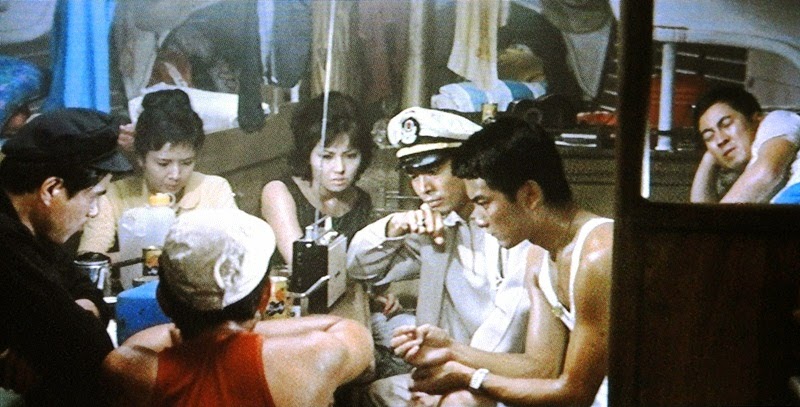


As we continue to look back at the work and art of those in Japan we turn to a film that enjoyed a regular residency on Saturday's Creature Double Feature out of Boston. It was one Honda's very best films and as a young person was sure to put hair on your chest. We take a close inspection of Toho and director Ishiro Honda's classic Matango (1963).

Honda turned in some of his most sterling work from the 1950s through the 1970s and Matango was a shining example of his genius with mood and atmosphere in the world of the creature feature.


Matango was also known as Matango, Fungus Of Terror and most notably stateside on Creature Double Feature as Attack Of The Mushroom People. That title alone scared the very young in front of tube televisions everywhere in the United States.

Instantly, images of films like Attack Of The Killer Tomatoes might spring to mind, but Attack Of The Mushroom People or Matango was legitimately terrifying as a kid. It was a frightening, creepy little tale that often had both young hands and fingers crossed allowing just one eye to peep through at the terror while sitting Indian style (that's probably politically incorrect now).


Ishiro Honda arrived with Matango during a prolific period beginning with the classic Gojira (1954), the sci-fi heavy trilogy The Mysterians (1957), Battle In Outer Space (1959) and Gorath (1961), Rodan (1956), Toho's first color kaiju film, Varan The Unbelievable (1958), The H-Man (1958), and Mothra (1961). Following King Kong Vs. Godzilla (1962) and Gorath (1962), Honda arrived with the sci-fi intensive Atragon (1963) and the freakishly spooky Matango (1963).

With Matango the prolific director gave us all a good scare by downsizing his look at kaiju horror with something much more intimate and effective in Matango.


As a child, I always found these kinds of films even more unnerving than the giant monster films. As a kid, both generated nightmares, but in my kaiju dreams, I always had the ability to run and flee from the approaching Godzilla. There was always a building to duck behind or a basement to hide within. I was able to evade the advancing lightning bolts or radioactive fire breath. Escape was always possible in those dreams. The giant monsters weren't looking for me specifically. But mushroom people! Holy crap, that was a whole different story.


With the more diminutive (all things being relative to Godzilla) creatures that would populate the likes of Matango there was nowhere to run and hide. They were roughly the same size as me and they could be around any corner, thus waking up altogether was an entirely good option. These things were horrifyingly real and creepy and thus left some of the most lasting impressions.


One must look at the wonderful care given to these films by Honda. Shot in Oshima, close to Tokyo, the cast spent the better part of a month in isolation recalled delectable actress Kumi Mizuno in Monsters Are Attacking Tokyo! (Stuart Galbraith IV, 1998). Honda told the group, "This is a very grim story, and I want you to take your roles very seriously" (p.84). Mizuno correctly asserted, "It was about man against man. That is, I think, the most attractive part" (p.85) of the film. That, of course, and Mizuno herself. I couldn't resist.


Matango, today, still remains incredibly bleak, haunting and infinitely mesmerizing in its use of atmosphere, silence, set design and a wonderful Japanese cast. Honda's use of color in capturing the ghostly interiors of a shipwrecked nuclear research vessel in the story is just one of those staggeringly beautiful gems of film production. Each room the character enters has its own color, light and look suggesting the vessel has literally become a part of the deserted island's growth. It has been assimilated by the fungus and molds alerting all that the island will usurp all that arrives there.


Matango centers on a group of oceangoing passengers - a Gilligan's Island (1964-1967) type group consisting of a skipper, his assistant, a professor, a celebrity, a writer, a singer - aboard a yacht that is caught inside the perfect storm. Coincidentally Gilligan's Island filmed its pilot, Marooned, in 1963, a few months after the release of Matango. Eerily a ship is spotted in the ocean mist and fog and, and like a siren, almost lures the travelers out of the fog and, and not to rocks, but to an equally life-altering uncharted island of mystery.


Once on the island, the survivors stumble upon the ghostly vessel. It is suggested there is a nuclear link and that the ship was studying its effects on sea life and the region.

This, once again for Honda, brings to the fore the Japanese connection culturally to a people's relationship with the devastating aftermath of World War II and the consequences of the bomb's discovery. Honda infused these concepts symbolically and poetically within Gojira and within his science fiction-heavy The Mysterians. These themes were a part of who Honda was as a director. It was, of course, lost on us as children taking in a thrilling Saturday entertainment, and dousing our eyes from the sight of horrors before us, but there was much more going on within Honda's story. Once again illustrating his substance as an artist as much as an entertainer. Like Gojira, Matango is one of his greatest successes in seamlessly fusing tale with theme.


As much as Honda built radiation into the story of Gojira, not as a "gimmick" like some American monster films would implement (though I think radiation was as much on the minds of Americans as it was the Japanese), but as "a symbol of the bomb," he too infuses Matango with that same message through mushrooms.


Matango relates to the island events of the American nuclear tests and delves into the "narrative device" to "discuss the terror of the nuclear age," according to Kalat in his book A Critical History And Filmography Of Toho's Godzilla Series (1997). While, Kalat speaks directly about Honda's approach to the Godzilla films in his book, the subject is perfectly fitting and applicable to such films as Matango and The Mysterians. These films were a part of who Honda was as a director. They are in step with his vision. Kalat notes wartime left an "enduring psychological scar" on Honda who "lived through the firebombings of Tokyo" (depicted quite graphically in director Isao Takahata's Grave Of The Fireflies). He was directly impacted by the horrors of Hiroshima and Nagasaki during World War II and the direct effects of radiation. Honda "felt compelled to translate the horrors of modern war." Again, Kalat speaks specifically to Gojira, but Honda's message is no less pronounced or underrepresented in Matango and elsewhere. Honda saw a chance to "make radiation visible" or "visual" as noted by Galbraith in Monsters Are Attacking Tokyo!. He achieved this through the symbol of Godzilla and his trademark radioactive fire breath. Honda achieves it in Matango through the  mutation of actual people horrifically disfigured as veritable mushroom people.


On March 1, 1954, the Marshall Islands were subjected to atomic testing with the detonation of the first hydrogen bomb. It was 1,000 more times powerful than those bombs dropped on Hiroshima and Nagasaki. Unfortunately, radioactive fallout spread across the ocean region. Once again, unfortunately, the Japanese fell prey to an American test. Off the coast of the Marshall Islands a Japanese fishing boat, the Lucky Dragon (Daigo Fukuryo Maru) fell victim. The crew of that ship was impacted by the radioactive cloud and became sick. Aikichi Kuboyama, the radioman of the vessel, died a few months later in September 1954. He was the first casualty of the hydrogen bomb. Anti-American sentiment grew exponentially along with the headlines in Japan following the incident.


This is historically significant to the development of Honda's vision of the ghostly ship in Matango, a tribute to the Japanese fishing vessel lost to radiation sickness, as conveyed through the symbols within Matango. Honda explores a similar set up concept concerning the radioactive event for his film The H-Man, years earlier, to equally gruesome effect. The horrors of nuclear radiation are indeed a visual reality for Honda. The Mushroom people are indeed symbols of the bomb and the consequences of nuclear horror on human beings.


Gojira was released shortly after the aforementioned events. David Kalat wrote, "Honda originally planned to make the connection to the Lucky Dragon even more explicit, and expected to start Gojira with the irradiated fishing vessel floating, completely uninhabited, back to its port like the death ship" (p.34). Honda was sensitive to the proximity of the events to his people. Honda admitted, "We skirted the issue, frankly speaking. We felt that putting a real-life accident into a fictional story with a monster appearing in the midst of it wouldn't sit well in the world of a film entitled Gojira" (p.23). Honda added in Galbraith's book, "I felt the atomic terror would hang around our necks for eternity" (p.23), and it has. Years later, in truth, Honda would bring that original vision to reality with the ghost ship of Matango and in his film's layered cautionary tale that ultimately suggests the fates of those aboard the Daigo Fukuryo Maru. The very island itself, the center of Matango's story, is symbolic of the Marshall Island event itself. The ghost ship, for all intents and purposes, is the Lucky Dragon No.5 (see also the 1959 film of the same name). Matango is Honda's most direct tale. It speaks to the horrors of those events.


As a vision of film, Matango's cautionary tale succeeds in spades due to great casting and a simple affecting story. The tale is told in flashback by one survivor now under psychiatric observation. He tells us the others are still alive, but never left the island. This is the set up and we are immediately intrigued by the premise and want to learn why as we witness Honda spin his web of magic implementing a script that was credited, believe it or not, to five different writers, including in particular Takeshi Kimura (1912-1988; The Mysterians, Rodan and many other classics). Honda's vision comes to life on screen as models (both of the miniature and Japanese babe variety), make-up and simple details are produced exquisitely for the eye.


Matango, renowned as a Japanese tokusatsu film, meaning a live action film fantasy, horror or science fiction film relying on special effects, boasts Japanese legend Eiji Tsuburaya (Gojira, The Mysterians and other Honda classics). Tsuburaya works wonders into the creation of this mythical and otherworldly place that becomes central to Matango. The setting and production design becomes a major character within the film. A selected filmography of Tsuburaya's marvelous and beautiful contributions can be found in the entry of the non-Honda film Godzilla Raids Again (1955) found here. Tsuburaya's suitmation work was particularly stunning on the so-called Mushroom People. They were anything but and when encountered seemingly came to life straight from the mystical island. Complete with a horrifying sound effect, the Mushroom People were one of the scariest things I had ever seen as a child as they moved to and fro in the forests towards their victims. It was truly mortifying stuff.


Matango was adapted from a short story by English author William Hope Hodgson called The Voice In The Night (1907). Hodgson's fungal concepts, found here in Matango, could conceivably have been pulled from another Hodgson horror tale called The Boats Of The "Glen-Carrig" [1907]. As a story, Matango is graced with considerably strong dialogue (the English dub is a little challenged, but I still eat that one up like a bowl of portabellas) for an ensemble cast and a good deal is revealed about each of the primary characters as the story grows darker and darker beginning with the revelation of a mutant Matango aboard the wrecked ship.


Slowly, as food considerations become dire and the idea of an island bountiful in fungus sustenance becomes readily apparent rash choices are made. Matango, for a film with its very short length of 89 minutes gradually becomes something of a body horror film and a film about resisting temptation and thus stemming inevitable transformation. Honda's film is as much about mutation as it is about radioactive contamination and its affect on a population and its food supply.


There's clearly something about those shrooms and the group is warned not to eat the mushrooms based on the log books found from the wrecked vessel. Is there something truly different about those mushrooms that affects nerve tissue? Is it the work of man? Could it be nuclear testing that has created a monster island of a different kind?
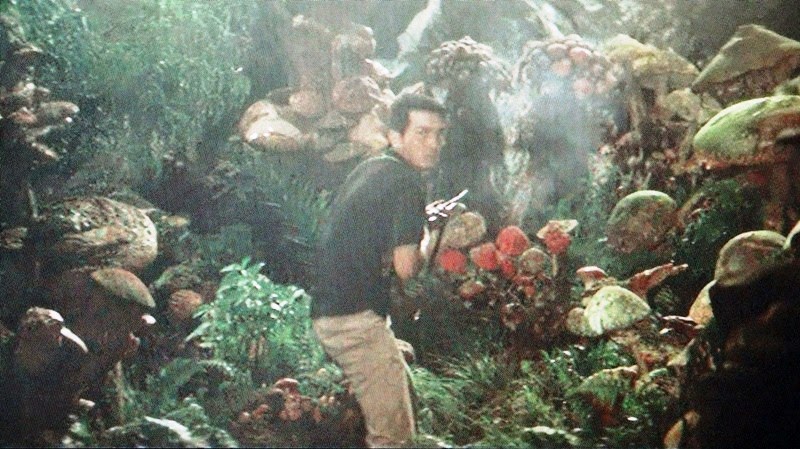


Furthermore, the log books indicate former ship members left to hunt and gather food, but never returned. With the island often shrouded in fog, these castaways are on their own. They begin to discover the island is a ship's graveyard and that even birds steer clear of it.


Then of course there is the theme of man versus man in this morality play. How far are we willing to go to fulfill our desires? Trust and distrust become central to the story. Gradually the fragile alliance of this loosely gathered makeshift team begins to unravel as distrust, fear, dread and desperation takes hold in this endlessly dreary graveyard. How far will we take our basest instincts? The story quickly devolves and becomes a grim snapshot of humanity and the human condition as driven by greed and weakness. The rain and bleak setting offers the antithesis of a lost paradise - paradise lost.


The hallucinogenic properties of the mushrooms lure and trap their residents like the siren lures ships to the rocks and their inevitable doom. In this twisted Eden of sorts, as Steve Ryfle notes in Japan's Favorite Mon-Star, the actors eat the proverbial, "allegorical 'forbidden fruit'" (p.100). There is indeed something twisted and dark about this place.

Even the creatures are used sparingly here to fill this claustrophobic or isolated tale and as a result events are intoxicatingly frightening.

The film paces itself evenly between the variety of characters and their minor discoveries building upon the creepy and the suspenseful. A mushroom-like figure is spotted in the forest. A disfigured fungal figure boards the vessel one evening. But these images are sometimes obscured or used sparingly to build the genuine horror of Matango.


Matango demonstrates how the human condition devolves throughout the film. Even when efforts are made to connect with others out of love Matango is unrelenting in its sadness. Finding that human connection becomes one of the film's final statements. We are left to believe we are ultimately alone repelled by things we do not know or understand.


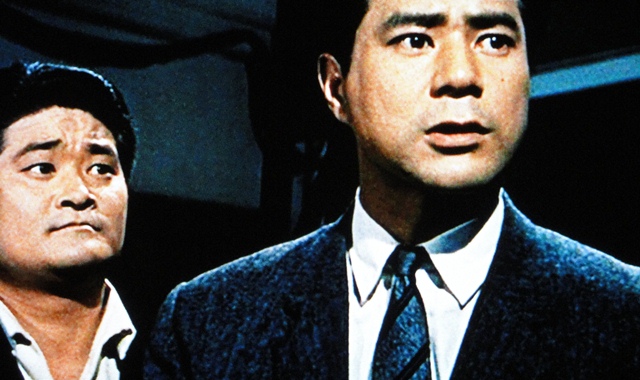
Matango is a satisfying, stark piece of horror and science fiction. It has a series of carefully woven, universally appealing themes. It is graced by a well-balanced cast with some uniformly strong performances, particularly by Akira Kubo, Kumi Mizuno and Hiroshi Koizumi (see below). It is matched with a beautifully-directed and seamlessly crafted film production. Tremendous effects work, set design and some gorgeous cinematography (Haijime Koizumi) populate the film throughout. It uses every minute of its short length to drive home a finely tuned story in riveting fashion, use its limited but exquisite set designs and tell the tale of humanity at its basest working together and against each other to survive. The Akira Kubo character was indeed the hero, but unlike today's super heroes he was but a mere ordinary, good man. It was with him we pin our hopes and yet even through him Honda surprises us. The moral of the story, as the Kubo character notes, even in Tokyo, like the events on the remote island, people are ultimately cruel and unkind. It is a devastating portrait of humanity and not for the faint of heart.


What impresses most is how much this film affected me as a child and how well I remember every frame of it. Even with my hands to my face as a child I was forced to return to this film that still holds up in quality today. That's the craft of a genius at work even if it based conceptually on someone else's material. He did it with a lizard named Gojira and he does it again with Mushroom People. Galbraith called Matango "an exquisite horror film about a corrupt group of urbanites shipwrecked on a foggy, rainy island," likening the human breakdown of social order to William Golding's Lord Of The Flies. And while the title Attack Of The Mushroom People, is a "wildly inappropriate" (p.30) for USA release, it doesn't detract from a quality film. Matango is essentially cinematic poetry connecting Honda's troubled soul over the nuclear past with the present reality and something viscerally traumatic. He digs in the dirt with Matango. It's a magnificent example of fantasy horror done absolutely right. Many Americans really missed the boat on this one, but the kids didn't and for me the film is as haunting today as the ghost ship used by Honda. There is a mood and atmosphere to Matango that is so refreshingly different from the Godzilla pictures. You may wonder how many times you can watch the great lizard stomp across a city or throw it down after seeing this one.

I'm inspired to get back to making my homemade mushroom soup. Even after a microwave reheat, that's one heck of a radiated dish you can eat!


Matango: A


On an anime note: Studio Gainax's Nadia The Secret Of Blue Water offers a riff on this film in one of its episodes.

The exceptional quality of its ensemble cast is one of Matango's great strengths. Mizuno and Kubo are two of the best.


Actress Footnote: Kumi Mizuno (1937-present). You talk about being in love as a child. I crushed on Kumi Mizuno like a wide-eyed Japanese school boy. I was in love with her like you loved your elementary school teachers. She was beautiful, sensual and sexy, a real dream girl. If the Internet existed back then my walls might have been adorned with Kumi Mizuno. Mizuno featured in a number of Toho/kaiju eiga classics including: Gorath (1962), Matango (1963), Frankenstein Vs. Baragon or Frankenstein Conquers The World (1965), Invasion Of Astro-Monster or Monster Zero (1965), Godzilla Vs. Ebirah, Horror Of The Deep or Godzilla Vs. The Sea Monster (1966), The War Of The Gargantuas (1966), Godzilla Against Mechagodzilla (2002) and Godzilla: Final Wars (2004).

Mizuno is beloved within the genre and her chemistry in three films opposite actor Nick Adams was notable. It is believed their attraction carried over to real life. They starred together in Invasion Of Astro-Monster, Frankenstein Conquers The World and The Killing Bottle (1967). The alleged affair took place while Adams was married at the time. Adams sadly died under mysterious circumstances one year after The Killing Bottle. The exotic Mizuno denied the relationship in 1996. Interestingly, Mizuno also starred opposite Kubo in three films. Mizuno was indeed an alluring siren for any man in these films. She was simply stunning.


Actor footnote: Akira Kubo (1936-present): Kubo has appeared in roughly 75 Japanese films. He has appeared in some classic Toho productions including: Gorath (1962), Matango (1963), Invasion Of Astro-Monster (1965), Son of Godzilla (1967), Destroy All Monsters (1968) and Space Amoeba or Yog, Monster From Space (1970). He appeared in Akira Kurosawa's Throne Of Blood (1957) and Sanjuro (1962) as well as Kill! (1968). He resurfaced in kaiju films with Gamera: Guardian of The Universe (1995). Kubo reflected on the always exotic attraction of Kumi Mizuno in Galbraith's Monsters Are Attacking Tokyo!. "I worked with her a lot. She got to be really gorgeous. Offscreen she was sexy and unpretentious" (p.79).


Actor Footnote: Hiroshi Koizumi (1926-present). Koizumi has appeared in a host of Toho/kaiju eiga productions including: Godzilla Raids Again (1955), Mothra (1961), Matango (1963), Atragon (1963), Godzilla Vs. The Thing (1964), Dogora, The Space Monster (1964), Ghidorah, The Three-Headed Monster (1964), Godzilla Vs. Mechagodzilla or Godzilla Vs. The Cosmic Monster (1974), The Return Of Godzilla or Godzilla 1985 (1984) and Godzilla: Tokyo S.O.S. (2003).


Wednesday, July 24, 2013

Science Fiction Non-Fiction: Ishiro Honda (Gojira)

"They called it grotesque junk, and said it looked like something you'd spit up. I felt sorry for my crew because they had worked so hard."
 
-Director Ishiro Honda referring to harsh criticisms of Gojira (1954) upon its release-


Some critics charged Honda with capitalizing on the trauma of the atomic nightmare visited upon Japan in 1945 through his film Gojira [1954]. Author Steve Ryfle notes Honda felt he succeeded in creating a classic in Gojira because he didn't quite tell the story he intended, or quite develop the scares he desired.

Honda noted, "As strange as it may sound, I think the film succeeded because I didn't completely succeed as a director.... It represents only 65 percent of what I wanted to achieve. Since I fell 35 percent short, audiences could see it wasn't a real story." [Steve Ryfle, Japan's Favorite Mon-Star, p. 38]


Director Guillermo del Toro has suffered some criticism for his film.  But like Gojira, I think Pacific Rim (2013) is a major statement in the world of kaiju cinema.  The mammoth production may one day achieve an even greater appreciation.


One thing is certain, both directors have an eye for beauty when it comes to selecting a Japanese actress whether it be the classic beauty of Kumi Mizuno (Matango) by Ishiro Honda or the equally classic Rinko Kikuchi (Pacific Rim) as chosen by Guillermo del Toro.
 
Okay Rinko, I'll settle for a hug.


The final credit of Pacific Rim is dedicated to Ray Harryhausen and Ishiro Honda.
 

Monday, January 7, 2013

Mothra

"One of Toho's best films... abandoning the semi-documentary style ... in favor of color-filled, dream-like imagery.  ... you've got a preposterous, beguiling fantasy."

-Stuart Galbraith IV, Monsters Are Attacking Tokyo: The Incredible World Of Japanese Fantasy Films [p.168]-


Up to this point, we've spent time looking at some of Ishiro Honda's earliest science fiction.  Gojira [1954] was dark - very dark, but was unstoppable in its singular vision to incorporate the political climate of Japan.  Only Godzilla Raids Again [1955] surprisingly went to another director.  Rodan [1956] was your classic, albeit, mostly grim Saturday afternoon creature feature.  The Mysterians [1957] and Battle In Outer Space [1959] were the first two components of his sci-fi trilogy.  Both were spectacular if a little devoid of the all-important human component.  The black and white Varan The Unbelievable [1958] demonstrated even less joy and was a generally plodding affair.  H-Man [1958] offered serious science fiction crime noir.   With the arrival of Mothra [1961] and the 1960s, things start to get interesting for Toho, Ishiro Honda, special effects wunderkind Eiji Tsuburaya producer Tomoyuki Tanaka particularly in their efforts to incorporate humor and humanity into their already smashing spectacle pictures.  If I had to recommend one to check out, Mothra would rank the best to date.  Still, this was just the beginning of Toho's fortunes as their fantasy pictures would become even more entertaining largely due to the influence and success of some of Mothra's ingredients as demonstrated in King Kong Vs. Godzilla [1962].


Mothra's tale begins following a storm as four survivors of the Genyo-Maru II are rescued from Infant Island and are observed for radiation sickness. Miraculously they survive lethal levels of radiation potentially saved by a red juice provided by the natives of the island.  Of course, Infant Island was a nuclear test site by the Rolisican government and there was no evidence of inhabitants to be recorded.  The island is symbolic, once again, of Honda's own nuclear fears and the testing that had resumed following World War II on the Bikini Islands between 1946 and 1958.  The Genyo-Maru II is representative of the fishing vessel caught in those tests called the Daigo Fukuryu Maru.  The Rolisican government is a fictitious government standing in for America.  These historical aspects have been well-documented to date in my coverage of all things Ishiro Honda.


An expedition team, headed by capitalist Clark Nelson and anthropologist/linguist specialist Shinichi "Chujo" Tyuujou, played by Hiroshi Koizumi, and radiation specialist Dr. Harada, is sent to Infant Island, a Polynesian island, as part of a joint effort between the Japanese and the Rolisican Embassy.  Once again, this underscores Honda's vision and belief that cooperation and coordination is necessary for a sustained peace and the proper application of technology and science.  Partnership is essential to Honda.


News reporters Zenichiro "Bulldog" Fukuda, played by a popular Japanese comedian Frankie Sakai and photographer Michi Hanamura, played by the lovely Kyoko Kagawa, join the team and add a certain levity and bounce to the often heavy-handed proceedings of the Toho kaiju eiga pictures really for the first time. This approach would become more pronounced and proved effective and popular in future films.  Sakai is perfect at balancing humor with the empathetic in his role never becoming a bumbling joke, but the comedic efforts of Toho can really trace back to Sakai here.


According to Stuart Galbraith IV in his book Monsters Are Attacking Tokyo!, actress Kyoko Kagawa [who played a reporter], didn't actually "remember working on these films at all."  That, of course, or she chose not to remember much like actress Yumi Shirakawa [The Mysterians, Rodan] who appeared to be embarrassed about discussing these projects on her curriculum vitae when also requested for an interview. Some actresses, but not most, clearly did not hold these pictures in high esteem.  Most Japanese actors and actresses embraced the fantasy films.


Suited up in radiation gear, the team begins to discover the unexpected and the fantastical on Infant Island. Chujo falls unconscious after being attacked by the local plants of the island, a vampire vine of some type.  But Chujo is saved by two small women as viewers are introduced to the popular singing duo The Peanuts.


Apart from the infusion of humor for Mothra, The Peanuts, the iconic fairies of Mothra, were portrayed by Japanese twins Emi and Yumi Ito, and delivered another fantastical layer to the genre.  The Peanuts were indeed a terrific visual gimmick of the sort popular in Sinbad pictures.  The girls were also Japanese pop stars scoring number ones through King Records in Japan in 1959.  They also recorded The Peanuts Around The World for Columbia Records and appeared on American broadcasts like The Ed Sullivan Show and The Danny Kaye Show.


Back into the jungles of bizarro land that is Infant Island, the team happens upon the fairies who are apparently speaking in some kind of indecipherable code.  Miraculously they are somehow interpreted by Chujo.  The fairies wish for their island to be unscathed from nuclear testing.  The fairies are picked up, like Fay Wray of King Kong [1933], by the Rolisican corporate sponsors, clearly representatives of evil and symbols of greed.  It is nearly comical to see them handling literal barbie dolls, but these were the days of real effects and Japanese barbies were the perfect substitute for the handling of real Peanuts with the absence of CGI.  Honestly we have come a long way, but I wouldn't trade that moment for all the advancements in the world - it's absolutely priceless! My whole family just howled.  I had trouble loading the video clip so the images will have to do.


Of course, most of the expedition is horrified by the actions of the two company men.  The natives literally grow restless, come out of the forest and demand the fairies be released.  They are set free.  The little girls wave.  They smile.  No hard feelings.  Incredible.  If I were the fairies I would have executed orders that these invaders be destroyed immediately, but Honda's message is always one of understanding and enlightenment while enchanting his viewers, until of course the villains abscond with the wee ladies and then all bets are off.


So the tiny beauties, as Fukuda calls them, or shobijin [small beauties], clearly inhabit an island impacted by nuclear testing but inform the expedition not to perform further testing.  We can only assume these islanders go underground during times of crisis.

Upon returning to the mainland, the expedition is kept hush.  It's somewhat surprising to see Fukuda silent on the events that unfolded.  Chujo and Fukuda unearth information on Nelson who had once trekked to the Amazon in 1954 in search of beautiful women for his entertainment empire.  You guessed it - The Peanuts are next!


So while Chujo explains to Fukuda that he has etched cave writings from Infant Island on a cloth that speak of Mothra, Nelson, meanwhile, has sent his cronies back to the island to abduct those wee little Peanuts.

The natives are massacred and the great Mothra is summoned by the bloodied tribal leader.  A rock face crumbles as the remaining islanders behold a beautiful, massive-sized Easter egg dubbed Mothra.


Before long publicity photos of the fairies start making their way in the world publicizing Nelson's latest effort.  They are a circus-like attraction dubbed The Secret Fairies Show.  Meanwhile, the newspaper wonders why Fukuda never spoke of these girls.  He does present a case for vindication explaining his desire to protect them seemed in the best interests of the islanders.  As a human being he felt it was the right thing to do.  Fukuda demonstrates a selfless side of his humanity.  Nelson on the other hand is shameless in his efforts to enslave the two fairy beauties.


Not unlike King Kong's island abduction the girls are brought back to the mainland and the civilized world for the benefit of making money.  The morality play that is greed is at the root of all evil is very much in play.  The fairies are abducted from the comfort zone of their island.  This is an alien place to them as much as New York was to King Kong.  But what the fairies can do that Kong could not is sing.  And boy can they sing!  Their tiny little golden pipes belt out some of the most beautiful notes and away they go entertaining the masses with their delightful songs. Honestly it's no surprise that Japan and other Asian nations churn out girl pop duos and girl pop groups by the dozens.  They are indeed easy on the eyes and their melodies are enough to lure you into a trance like the songs of a siren luring ships to the rocks.  Just gorgeous.  Each film's production number has become something of a Honda staple when considering H-Man and Rodan both highlight similar nightclub-like productions.


Additionally, the fairies' song appears to transmit and speak to their native islanders who are chanting and singing a similar song on Infant Island summoning forth Mothra like the natives on Skull Island.  Of course, this makes sense as later we learn that the girls can telepathically communicate to their islanders and perhaps Mothra.

On the mainland, Chujo and Fukuda discover Nelson is confining the girls in a bird cage.  Unfortunately, the girls warn that many innocents will die if they are to be saved.  Mothra is coming.


The great egg cracks and a larvae bursts forth.  The imprisoned fairies are headline news photographed by Kyoko secretly.  The larvae worm is floating across the ocean.  Mothra is coming!


The girls sing and their sounds beckon to Mothra as it makes its way across the sea with Tokyo the target, once again, of another terrific Tsuburaya creation.  Like the harbinger of death, Mothra is coming.

Chujo requests the fairies send Mothra back home.  Unfortunately, Mothra is a creature of instinct hell bent on saving the islanders.  It is a force of nature, a beast without a moral compass or understanding of right and wrong.  Mothra is pure mission and it is ironically a maternal one to save her inhabitants even at the expense of the living to do so.

Still scientists believe they can use a synthetic material from nuclear reactors [could material from the fires of something so evil be utilized for good?] to shield the fairies' brainwaves and thus hide them from Mothra.  In effect, maybe Mothra will leave. This merely masks a moral wrong and that will never go unanswered.


Mothra's advance brings about the launch of Japanese fighters and the usual Japanese onslaught begins.  But Mothra's advancement to save the girls is an interesting twist, moreso than Rodan, because Mothra generates great sympathy.  Rodan acted to save a fellow winged creature.  Mothra acts to save human islanders.  It is acting solely out of a need to save lives that were wrongfully sequestered.  This can only be the beginning of what would become a love for a national icon in Japan.  Unlike Godzilla, Mothra is entirely a feminine phenomenon and its maternal instincts find great support from fans of the kaiju eiga series as much as it finds sympathy from those who understand its mission to save life.  It explains why Mothra has appeared in several Japanese films.


Meanwhile, Rolisica supports Nelson's rights abroad as a businessman. Not a good decision.

As Mothra wreaks havoc and takes lives, Shinichi, Chujo's young brother, sneaks into Nelson's place to rescue the fairies.  The scenes of devastation are truly impressive once again thanks to Tsuburaya's model work.  Mothra, the creature itself, even in its larval form is striking.  Rodan looked great, but Mothra is a marvel as it crawls along the ground in epic fashion, a truly original, juggernaut of a thing that doesn't come off as a man in a suit.  It seems to slink along walking upstairs alone or in pairs [think Godzilla Vs. The Thing] and making a slinkety sound, a thing, a thing, a marvelous thing - everyone knows its Mothra.  Based on the evidence here Godzilla has nothing on this little fellow.


When it reaches Tokyo Tower, Mothra undergoes its infamous transformation sequence as it begins spitting its webbing.  Mothra is undergoing its chrysalis phase.  Mothra reborn, phase two, is coming!

Mothra is fully cocooned.  All out attacks commence on the cocoon in accord with the Rolisican government.  Heat rays are employed.  Meanwhile, Nelson and his cronies have escaped to the island of Rolisica with their two fairy beauties.  They taunt them to sing and unknowingly tell them Mothra has been destroyed, but Mothra has merely finished its transformation into a big fluffy, lovable Thing.


In Tokyo Mothra breaks free of its cocoon and more havoc ensues.  The flying creature is a gorgeous, colorful creation of the imagination with wing power reminiscent of Rodan for sheer destructive capability causing all manner of carnage, but a wing span to behold too.  Tsuburaya never tired of destroying his model creations.  In fact, comically enough, despite the near annihilation of modern civilization everyone still smiles and waves goodbye to Mothra by episode's end.  This is clearly a creature that is not misunderstood and a great reservoir of empathy lies within the hearts of the Japanese people for its existence.  No hard feelings.


Mothra wasn't some clunky monster hell bent on destruction for destruction's sake - a nightmarish creation of the atom bomb.  No, Mothra was summoned as a beautiful monstrous savior of two island girls wrongfully abducted and absconded back to the mainland for a road show tantamount to King Kong mania.

What of the fate of New Kirk City [you can't make this stuff up, but the Japanese can]? Nelson?  Mothra?  The tiny beauties? This and more in the final minutes of Toho's fantasy extravaganza that is Mothra.


Mothra was the third in Honda's approach to "the trappings of American 'giant insect' movies of the 50s" [p.29], noted Galbraith IV. Clearly, the aspect that appealed most to the youth in America was its extreme sense of fantasy that was uniquely or "singularly" Japanese. As Gailbraith noted, Mothra was a "colorful, impossibly large moth whose flapping wings create hurricane-sized wind storms" that wreaked havoc and was ultimately "vivid and imaginative but, perhaps, a bit bizarre for American audiences" [p.29], yet, again, kids seemed to understand these films like myself. There was indeed a "dream-like" quality to these Japanese fantasy pictures. They were immense and beautiful. Mothra remains an icon of the Japanese kaiju eiga genre that may be potentially the most popular next to Godzilla and Gamera.

Mothra succeeds not just largely on the breadth and scope of imagination provided by Honda and Tsuburaya but by infusing the story with a host of real characters and good humor making Mothra one of the most entertaining and fun of Honda's fantasy pictures.  More than Rodan, there is much more humor and character abound in Mothra making it the most fun to date.  Mothra represents the third film in Honda's rise to acclaim as a monster movie director.  Gojira set the world afire, while Rodan added to the mystique of the men behind Toho's kaiju eiga, but Mothra was the film that cemented a reputation for the creative team that seemed to really bring together elements of character and story to their special effects creations.


The film was based on the book The Luminous Fairies And Mothra with a terrific adaptation to script by key writer Shinichi Sekizawa. This is Sekizawa's best screenplay to date following the humorless Varan The Unbelievable [1958] and the sterile but visually appealing Battle In Outer Space [1959].  As Kalat noted in his book, A Critical History And Filmography Of Toho's Godzilla Series, Sekizawa gave Honda's "escapist family movies a deeper level of sophistication."  Sekizawa would become known for the fantastical lighter fare, while Takeshi Kimura would be known for the darker works [see writer footnote in Rodan]. Mothra proves things are about to get even more interesting with Honda's kaiju eiga.

Mothra: B+. Director: Ishiro Honda. Writer: Takehiro Fukunaga, Yoshie Hotta, Shinichiro Nakamura, Shinichi Sekizawa.


"Mothra... was not so much a horror movie as an action fantasy for the whole family, a tone that better suited the brightly colored, widescreen spectacle Toho's kaiju eiga had now become." -David Kalat, A Critical History And Filmography Of Toho's Godzilla Series [p.44]-


Additional Commentary:
As writer David Kalat notes complementing my own reflections in the conclusion, the Japanese people, in essence, embrace Mothra, unlike Rodan and Godzilla.  The people wave goodbye to the great island creature and even welcome its return.  Kalat notes Mothra is indeed a force like Rodan, "but she is not a menace to be destroyed" [p.63].


Kalat accurately notes that Toho and Honda began moving in the direction of Mothra with Rodan's own "crudely defined" personality.  Mothra has "intelligence" and "noble motivations."  Kalat states that the real villain here, or monster, is not Mothra, but rather the "greedy capitalist Clark Nelson."  One could certainly argue that man has always been the villain to a certain extent even with Godzilla.  Though Godzilla hardly attacked with noble intent as Mothra does here in Mothra. The legendary Godzilla was spawned by the villainy of atomic weapons created by the hands of man and his quest for power.  This has always been at the heart of Honda's message.  Granted, Kalat's point is well-taken and Mothra takes a giant leap into fantasy from the much grittier darker world of Gojira and even the empathetic world of Rodan.


Elements of humor are abound here and Mothra embraces a human dynamic and dramatic component within Mothra absent from some features to date.  This popular amalgamation with would reverberate for decades as part of the Toho fantasy.  Mothra even introduces children to the mix offering a glimpse of another popular element to the kaiju eiga pictures of the future particularly popularized by the Gamera pictures and Daiei Studios.  I mean Mothra even pre-Gamera's the corner on the kid market.


But ultimately it is the humanity and humor of a terrific ensemble cast and their chemistry combined with an empathetic approach to Mothra with more complex motivations that makes Mothra such a success and awakens Toho to even greater possibilities to come.  In fact, many of the elements that would make Mothra such a success would be reconstituted and fortified to greater effect in King Kong Vs. Godzilla, as mentioned earlier, also penned by Sekizawa.  Kalat accurately notes these ideas would be "recycled" reappearing in other pictures.  Toho knew how to mine a good thing.


The tiny beauties and the incorporation of The Peanuts is also a clever visual touch adding further depth to the story and character ensemble.

Thematically, Mothra is a fantasy picture immersed in anti-capitalism, as both Galbraith IV and Kalat note in their books.  Kalat states Mothra was filmed during a period of economic rebuilding in Japan and Mothra is a "critique" on Western values and capitalism.  Perhaps it was a cautionary tale as well for Japan's own socially-conscious, but capitalistically-driven culture.  As Kalat reflected, Japan still puts the "social good over pure profit."  Kalat points to Aliens [1986] by James Cameron as a film with a similar message but distinctly noting that Mothra is a "family" picture firmly grounded in the fantasy world.


Additionally, the theme of religion is also in play through Mothra's use of crosses and its underscoring of Mothra as one of the "monster-gods." These creatures are like "superweapons" moderating between competing groups in the films.  This theme can be seen in all manner of Toho films such as Godzilla Vs. Mechagodzilla [1974; also known as Godzilla Vs. Cosmic Monster] as one example.  Civilians and innocents always die as Kalat notes.  "The army is always powerless."  The creatures will not relent until some form of cooperation or peace can be resolved.

Once again, Mothra, as a creation, as Kalat notes, though self-evident and noted earlier, is "beautiful, colorful and elegant, simultaneously delicate and powerful."


Actor Footnote: Hiroshi Koizumi [1926-present].  Koizumi had a number of feature film roles within the genre for Toho. His films include Godzilla Raids Again [1955], Mothra [1961], a favorite and a strong role in Matango [1963], Atragon [1963], a return for Mothra Vs. Godzilla [1964] as a different character, Dogora [1964], Ghidorah, The Three Headed-Monster [1964], Godzilla Vs. Mechagodzilla [1974], The Return Of Godzilla [1984] and finally Godzilla: Tokyo S.O.S. [2003].  As you can see, Koizumi is a notable figure in some of the very best of the genre favorites from Toho.


Actress Footnote: The Peanuts: Emi Ito [1941-2012] and Yumi Ito [1941-present].  Pop singers who portrayed the pint-sized tiny beauties as the fairies in Mothra. Enjoyed pop success on the Japanese charts in 1959 and recorded one English language pop recording. They were cast as the shobijin [little beauties] in Mothra. According to Steve Ryfle in Japan's Favorite Mon-Star they were popular probably less for their talents and more for their "speaking-in-unison shtick and Eiji Tsuburaya's trick photography" [p.101].  They have a fairly extensive discography and the sibling duo retired in 1975.

Writer footnote: Shinichi Sekizawa [1921-1992]. Sekizawa would begin making a significant name for himself opposite Takeshi Kimura who was also one of Toho's notable scriptwriters.  Most of the kaiju eiga genre favorites were either written by Kimura [see writer footnote in Rodan] or Sekizawa.  Both screenwriters have since passed away.  Sekizawa's highlights are many including: Varan The Unbelievable [1958], Battle In Outer Space [1959], Mothra [1961], King Kong Vs. Godzilla [1962], Atragon [1963], Mothra Vs. Godzilla [1964], Ghidorah, The Three-Headed Monster [1964], Dogora [1964], Invasion Of Astro-Monster or Godzilla Vs. Monster Zero [1965], Godzilla Vs. The Sea Monster [1966], Son Of Godzilla [1967], Godzilla's Revenge [1969], Latitude Zero [1969], Godzilla Vs. Gigan [1972; written with Takeshi Kimura], Godzilla Vs. Megalon [1973; written with Takeshi Kimura], and Godzilla Vs. Mechagodzilla [1974].  The man was like the J. J. Abrams of his day he was so busy.  He was a definitely a Toho favorite along with Kimura.


Actor footnotes: Akihiko Hirata [See The Mysterians] and Takashi Shimura [see Gojira].